SIMPLE TIPS
Algo Jour(n)al


HI FRIENDSSS!




This isn’t just a magazine. This is Algo — in faces, stories, and ideas.
Here is the idea: How do we promote unity and keep steady flow of news and gossips through the company?
Okay, but what is this magazine anyway?
We were searching for a format that would help us stay one team however spread we are across the Globe
Hence, from the idea of unity the Magazine was born (AlgoMag)
Got something worth sharing? Join in — write, ping, call!
Shall we get started?
🔥
🔥
a place where:
the most exciting stories from the Algo universe are collected
you can discover what your colleagues are up to (yes, even in other teams!)
we talk about trends, tech, and tools
we share stories about people, projects, and cool insights and hey, maybe even feature you!
the most exciting stories from the Algo universe are collected
you can discover what your colleagues are up to (yes, even in other teams!)
we talk about trends, tech, and tools
we share stories about people, projects, and cool insights and hey, maybe even feature you!
Here it is — the very first issue of our internal magazine, yo!
Please welcome - the very first issue of our internal magazine!
✌️
Why now?
We keep growing, we live in different countries in almost every time zone available, and we somehow manage to see each other once every couple of month which is, let's admit, not nearly enough! But our all hands meeting cannot possibly fit all there is to share, right?


🎉
🎉
🎉
🎉
🇲🇽
🇲🇽
🔥
🔥



Did you know that?

🔥

The term All Hands comes from the sea: when a captain shouted “all hands on deck”, it meant everyone had to come up on deck — every single person’s help was needed.
American corporations started using this phrase in the last century whenever they needed to gather absolutely everyone. In the 1980s, tech companies picked it up too: Intel, Apple, and later Google.

Game changers
Stories

Toolbox
What’s Up, Algo?
Beyond the Screen
Join the Game

The wait is over… a new adventure starts now!
01
USA based
02
Forget Bitcoin. We’ve got Algocoins
03
04
Growing Roots in Indonesia
Custom Math? Yeah, There’s an AI for That
05
From clicks to money: Platform refresh
06
Hola, Insights! LATAM team Blog just dropped
07
Mexico
Currently, more than 900 children are enrolled in offline schools in Indonesia
The number is steadily approaching the first thousand!
+1000
Growing Roots in Indonesia
Why it matters:
These early sessions lay the foundation for ongoing courses that will empower kids with skills of the future.
Algonova
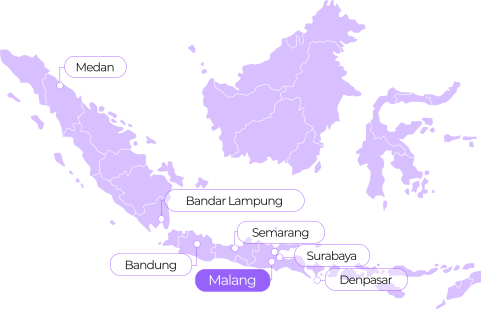
Seeing the bigger picture: Malang is now a key point on our Indonesia map, joining other Algonova schools already inspiring young learners. Each dot represents a hub of creativity, curiosity, and digital skills — and Malang is the newest bright spot.
Every new school strengthens the Algonova network across Indonesia, making high-quality digital education accessible to more kids.
We can’t wait for new spots to pop up on the map in 2026!
The first pre-class is not just an opening — it’s a community-building moment. Parents meet other families, students get excited about learning, and the team connects directly with the local community.

These early sessions lay the foundation for ongoing courses that will empower kids with skills of the future.

30%
250
Diagnostics converting 10 p.p. higher (25% → 35%) — super promising trend
tutor course sales already
of total Math revenue in October came from tutoring

Math Tutoring is Algonova’s next-gen take on personalized math education — an intelligent learning system that adapts to each student, not the other way around.
What started as an experiment — to prove that personalization in education can be technology, not just a slogan — has now grown into a full-fledged product with proven product-market fit.
It quickly became a margin driver for the company, covering every student goal from improving grades to prepping for Olympiads and international schools.
Custom Math? Yeah, There’s an AI for That

We set up a blog in Tilda Flows — this allowed us to quickly launch the project without a long development process and immediately establish a convenient publishing system. Right now, the blog is gradually being filled with articles (so far only 1 article per week). We choose topics based on a combination of high-volume trending queries, long-tail keywords, and evergreen content that will work in the long run.
Nastya
Product Marketing Manager
Product Marketing Manager


Our colleagues have just launched their own blog — and it’s already buzzing with insights and stories you won’t want to miss.
Here are just a few hot topics they’re diving into:
Robux & Roblox: freebie or scam? What every parent really needs to know.
AI for kids: smart ways to use it safely (and without stress).
Social media at home: digital safety tips that actually work — no family drama required.
AI for kids: smart ways to use it safely (and without stress).
Social media at home: digital safety tips that actually work — no family drama required.
Hola, Insights! LATAM team blog just dropped
The blog is in Spanish, but don’t let that stop you: Google Translate has your back. One click, and you’re in.
We’ve already stumbled on a couple of eye-opening ideas — and you’ll definitely find something that makes you go “wow.”
Big W in Q2! 🚀
We dropped a new edu track on the platform — now students can actually see when their paid lessons are about to run out. Once they hit zero, the next ones lock 🔒 — but here’s the cool part: they can message their parents right from the platform to ask for a top-up. Smooth, right?
Here’s the glow-up in numbers:
412 students hit that reminder button → 211 parents got a WhatsApp ping 📲 → and 45.5% of them bought a new package
Overall for Q2:
Students due for prolongation: 5,337
💰 Renewed: 2,248


From clicks to money: Platform refresh
Big news — all our Indonesia Online students (12K+!) are now using AlgoCoins, our in-platform currency. No more “testing” — since October, everyone’s in the game!
Here’s what’s been happening so far:
Kids have already bought 339 sticker packs and every single available Robux subscription in the store
Kids have already bought 339 sticker packs and every single available Robux subscription in the store
On average, teachers hand out AlgoCoins around 1,000 times a day — and on Saturdays, it can go up to 3,000+ times. That means students are really using them — this isn’t just another shiny feature.
What’s next:
In November, we’re rolling out new automatic events — students will start earning coins for their main platform activities. Even more ways to play, learn, and earn 🚀
In November, we’re rolling out new automatic events — students will start earning coins for their main platform activities. Even more ways to play, learn, and earn 🚀
What’s next:
In November, we’re rolling out new automatic events — students will start earning coins for their main platform activities. Even more ways to play, learn, and earn 🚀
In November, we’re rolling out new automatic events — students will start earning coins for their main platform activities. Even more ways to play, learn, and earn 🚀
Hey Stesha! We heard you and your team launched Algocoins? That sounds new — can you tell me more about it?
Hey hey! Oh yes, it’s an awesome story, I’ll tell you everything now


We reward students with AlgoCoins for awesome learning and olympiad wins — it’s a great motivator and perfectly fits our strategy.


Forget Bitcoin. We’ve got Algocoins
Malaysia: Our Next Big Step in ASEAN
After months of research and conversations, we’re opening a new country — Malaysia. Out of 15 markets we analyzed, it stood out as the one that feels both familiar and full of new energy. Malaysia matches our rhythm — ambitious, curious, and ready to grow through learning. It’s part of Southeast Asia, where our biggest B2C business already thrives, which means we can move fast, keep launch costs low, and build on what already works.
At the same time, it’s a wealthier, tech-driven market that’s just beginning to open up. Families invest heavily in education, digital skills are in demand, and competition in kids’ STEM is still moderate — giving us space to lead early.
Malaysia offers exactly what we need: a region we know, a strong economy, and the chance to make a meaningful impact.
Fast-growing digital economy
The IT sector contributes 23.5% of GDP, showing just how much demand there is for tech and coding skills — exactly our field.
Low competition, high entry ease
The kids’ STEM and coding segments are only starting to develop. With simple legal and financial entry processes, Malaysia gives us a rare first-mover advantage.
Education-first mindset
Over 70% of parents hire tutors. Education is still the key social elevator, and parents are ready to pay for results
The wait is over… a new adventure starts now!
USA BASED
Algonova has established a legal entity in the U.S., in Delaware. Why we chose to do it — and why Delaware — will be explained by Vlada Head of legal
Vlada, can you tell us what this opening means for us?
Establishing a holding company in Delaware is a strategic move that formalizes our international focus and lays the foundation for sustainable growth. We also plan to gradually transition operational activities to the U.S.—more details will follow in due course.
Okay, cool.
Why Delover?
Why Delover?
We chose the United States, specifically Delaware, because it is a globally recognized jurisdiction with a clear, flexible, and predictable corporate structure. Delaware is considered a benchmark for technology companies, particularly in terms of attracting investment, protecting shareholder rights, and facilitating international scalability.
It seems clear now, we will wait for more news.

STORIES

And today, we want to share with you a story from Egor — someone we can truly call a traveler. He’s a master at combining work with his love for exploring the world. This story isn’t exactly new — Egor’s adventures took place about half a year ago — but during that time, he visited Brazil, Argentina, Chile, Guatemala, and Ecuador. If you’ve ever dreamed of traveling to these places, this story is for you. The views, photos, and impressions Egor brought back were so inspiring that we simply couldn’t resist sharing them with you.

February was pretty calm, so not many photos — plus we had a small misadventure. After Patagonia we stopped for a couple of days in Santiago. Then came two dreamy weeks in Maragogi, Brazil: warm turquoise water, palm beaches, a cozy house with a courtyard, and sunrise walks by the sea.

Next stop was Olinda and its traditional carnival — very different from Rio. Here people dance frevo and parade with giant puppets. The streets were full of music, dancing and laughter… until my wife’s phone disappeared from a buttoned pocket. No photos from that night, and we skipped the next day. Still, Brazil felt amazing: tropical, vibrant, and full of kind people, even when we only talked through Google Translate.
Let’s be honest — traveling is important. It keeps us alive, happy, and open to the beauty of the world. So if you get the chance — go travel!


By the end of the month we were back in Chile, this time in the Lake District. The journey was intense: flights, a long boat ride, buses, heavy rain, sore knees, wet luggage. Finally we settled in Futaleufú, a quiet town near Argentina. Right now we’re horseback riding, tomorrow rafting. We’ll be here until April.


In Argentina we went to Bariloche — a city with incredible views of lakes and mountains and… the chocolate capital. We bought enough chocolate to last the whole trip. Spoiler: it was gone the very next day. On the weekend we went hiking in the mountains, camping with a tent, and saw something unexpected: two bulls fighting right on the trail.
The first town was Futaleufú. Surprisingly, it’s not easy to get here, and you can cross the whole town in just 20 minutes. But this is where we tried rafting for the very first time — and right away on a river that’s in the world’s top 3!


The difficulty level was 4.5 out of 5, but we never flipped over and no one fell out of the boat (even though we were warned it could happen). At the end, they even suggested we just jump into the cold water… and we did :) It was fun. Rafting — love from the very first time.

Then we stayed in Cochamó, on the shore of a Pacific fjord. A very quiet and pleasant place. We kayaked to a lighthouse… and then a walrus came out of the water. We turned around and paddled back :) We had already kayaked with sea lions and knew they sometimes try to climb into a kayak or even flip it over. And a walrus — well, it’s bigger, and not exactly playful.

And each of them looked the size of three or four cows — no joke. We had to go around through the forest, and even at night we could still hear them roaring loudly.

The final stop was Pucón. Because of injuries our plans changed, but only for the better. Instead of biking, we visited two waterfalls. The first — from inside a hot tub, especially cool when the air is chilly and drops from the waterfall hit your face. The second — by zip-line, the most extreme we’ve ever done: fast, high, and breathtaking. What we had: fast, high and breathtaking.

Then came the volcano hikes. We climbed Santa María — from 2,300 up to 3,800 meters — to see the nearby Santiaguito erupt. Instead, we got clouds, altitude headaches, and only a glimpse of ash rising above the fog. After that we tried Volcán de Fuego, one of the most active volcanoes in the world.

The last stop was Ecuador. In Quito we visited beautiful cathedrals and tried chocolate that locals treat like wine. Their 100% bars taste more like 70% — not bitter at all, but rich and complex. Nearby, in the village of Mindo, we saw hundreds of butterflies and tiny hummingbirds flying all around us in the morning. A perfect ending to a journey full of surprises.


Guatemala also gave us the ruins of Tikal and Yaxhá — ancient Maya temples hidden deep in the jungle. And the roars we heard at night? Not jaguars, not pumas… but howler monkeys. Still scary enough!

But, of course, we were unlucky again: for the first time in years it had stopped erupting. So instead of freezing in a tent at 0°C, we swapped the tour for a fancy hotel and a hot jacuzzi with a volcano view. Honestly? The best choice.
AI is slowly — or maybe not so slowly — becoming a part of everything we do. We ask it for advice, help, ideas, and sometimes even therapy 😅
How often do you use AI on a daily basis?
And… how much do you think ChatGPT actually knows about you? 👀
And… how much do you think ChatGPT actually knows about you? 👀
It might feel a little scary how fast it’s spreading, but let’s be real — when used wisely, AI can seriously upgrade your life and work routine.
That’s why we’ve launched our very own AI Tools Library here at Coda!
It’s small but mighty (for now 💪) — and it’s going to keep growing and evolving.
Konstantin Sorokin
Support Supervisor
AI Is Here to Stay
TOOLBOX

Alisa Sazonova
Product Manager
I often use AI tool NotebookLM
GPT Prompt Hacks
Grok
Claude
Perplexity
It’s an AI-powered research assistant that helps me work with books and audio materials. I upload texts or transcribed audio files, and it quickly creates summaries, study guides, notes, and even FAQs. It's incredibly useful for organizing information and making sense of large volumes of content — all in just a few minutes
Many people know about assigning a role in the prompt, but here are a few more useful tricks:
If you want the model to pay special attention to something, WRITE IT IN ALL CAPS.
Before asking for a response, prompt GPT to ask clarifying questions - this often leads to better answers.
Repeat critical points 2–3 times in different wording to increase the chance GPT won’t miss them.
Use “Ignore previous instructions” to reset context if GPT seems stuck in one line of logic.
Clearly state what GPT should not do -e.g., “Do not use bold text” or “Do not repeat the prompt.”
If you want the model to pay special attention to something, WRITE IT IN ALL CAPS.
Before asking for a response, prompt GPT to ask clarifying questions - this often leads to better answers.
Repeat critical points 2–3 times in different wording to increase the chance GPT won’t miss them.
Use “Ignore previous instructions” to reset context if GPT seems stuck in one line of logic.
Clearly state what GPT should not do -e.g., “Do not use bold text” or “Do not repeat the prompt.”
Dmitrii Zausaev
CTO
Cursor – for scripting, data-driven research, and rapid prototyping; I use it almost every day (prototyping, custom Jira reports, GitHub reports, etc.)
ChatGPT + deep research – a daily tool for comparing ideas, exploring alternatives, and validating assumptions
Replit – for quick prototypes and personal projects
Codex – now used mainly out of curiosity
Midjourney and BeFunky – for hobby projects and other personal use.
Grok uilt for clarity and results. Great when you need real-time insights, logic-driven answers, or solid data—no fluff. While ChatGPT leans creative and Claude plays it safe, Grok’s the straight shooter.
Unique edge: Reads X posts, code, images, and PDFs like a pro.
Fact: Sci-fi inspired and constantly updating, it brings bold, informed takes - perfect for markets, tech, or math-heavy work.
Unique edge: Reads X posts, code, images, and PDFs like a pro.
Fact: Sci-fi inspired and constantly updating, it brings bold, informed takes - perfect for markets, tech, or math-heavy work.
The ethical brain of the bunch. Designed for thoughtful, safe responses — ideal for reviewing documents, code, or sensitive topics. Compared to Grok’s edge, Claude is the steady advisor you’d trust with compliance or ethics.
Unique edge: Handles massive texts and sticks to strict fairness rules.
Fact: Born from ex-OpenAI founders, it’s known for razor-sharp reasoning - just don’t expect it to gossip about risky stuff.
Unique edge: Handles massive texts and sticks to strict fairness rules.
Fact: Born from ex-OpenAI founders, it’s known for razor-sharp reasoning - just don’t expect it to gossip about risky stuff.
The Swiss Army knife of AI — fast, versatile, and surprisingly deep. Great for market analysis, patent research, project planning, or even learning English through flashcards (yes, like Duolingo with a brain). It’s your “do-everything” AI assistant.
Unique edge: Combines real-time web search, data summaries, and interactive research in one clean interface.
Fact: Launched in 2022 and already handling millions of daily queries, it’s the multitasker’s dream - your smartest tab for getting stuff done.
Unique edge: Combines real-time web search, data summaries, and interactive research in one clean interface.
Fact: Launched in 2022 and already handling millions of daily queries, it’s the multitasker’s dream - your smartest tab for getting stuff done.
AI and other important tools for daily routine
Vibe-coding
Replit
Lovable
Cursor!!
Windsurf
Codex
Claude Code
Design
Midjourney
Canva Pro
UXPilot
chat.qwen.ai
AI meeting notes
AI Notion
Tana inc
Whisper / MacWhisper
Reseach
ChatGPT deep research
Perplexity AI
Analytics and Fin Modelling
Shortcut.ai
Video generation
Veo 3
Sora 2
Higgsfield
Generate creatives
GPTs for creatives
Figma AI
Whisper / MacWhisper
Audio-to-text
Turboscribe
Whisper
Translation
Livepools
DeepL


Beyond the Screen
9 AM
10 AM
11 AM
2 PM
6 PM
7 PM
8 PM
5 PM
8 AM
And today we’re spending a day with Anas Rosyid Alamsah!
Anas is a city manager at a school in Bandar Lampung, Indonesia. There are 211 kids studying there offline — looks like Anas has a really interesting job
Most of the time, we see each other through a screen.
A huge part of our team has never met in person — we know each other only by the part that fits into a Google Meet window.
Running
Checking class
Content making
Сelebrate birthday with team
Making events for students
Playing games (FC Mobile)
Playing guitar, singing classic rock song
Holiday with family
Breakfast
Each of us is a small universe — with our own lives, routines, passions, and families. In this series, we’re peeking beyond the screen to see what a day looks like for our teammates: how their calendars flow, what fills their time, and what inspires them outside of work.
Daily routine
Morning routine
At the office
At the office
At the office
At the office
Refresh time
Refresh time
Refresh time

But what’s beyond that frame?
1 PM

What is your current role at Algonova?
I’m the City Manager of Bandar Lampung Branch, leading daily operations, supporting the team, and making sure students and parents have a great experience.
What did you do before joining Algonova?
Before Algonova, I was a junior high school teacher, worked as technical support at a government institution, did freelance digital marketing, and even worked as a sailor on a tugboat.
Share three principles that guide your work.
Empathy: Always try to understand and connect with parents, students, and the team.
Creative Innovation: Bring new ideas and solutions to improve the way we work and learn. Growth Mindset: Embrace challenges as opportunities to learn and keep growing.
Creative Innovation: Bring new ideas and solutions to improve the way we work and learn. Growth Mindset: Embrace challenges as opportunities to learn and keep growing.
“Numbers of the Day”
2
4
Countless
Student smiles
Songs played on guitar :
2
Cups of coffee:
5
Meetings :
Goals scored in FC Mobile :
7.300
Steps walked :
Fun Extras :


In this series, we spotlight people who’ve turned their industries upside down — visionaries, rebels, and creators who changed the game for everyone.
When kids learn to code, design games, or solve problems through logic — they’re not just learning skills.
They’re learning to create, to experiment, to dream — just like the innovators who change the world. And few embody that spirit better than Hideo Kojima — a storyteller, creator, and visionary who turned gaming into an art form.
They’re learning to create, to experiment, to dream — just like the innovators who change the world. And few embody that spirit better than Hideo Kojima — a storyteller, creator, and visionary who turned gaming into an art form.
Game Changers: those who play to change the rules
Some people don’t just play the game — they reinvent it.
They take risks, break the script, and prove that imagination can rewrite reality. That’s what our new “Game Changers” series is about — people, projects, and stories that remind us: everything starts with an idea. We believe in the same thing.
Some people don’t just play the game — they reinvent it.
They take risks, break the script, and prove that imagination can rewrite reality. That’s what our new “Game Changers” series is about — people, projects, and stories that remind us: everything starts with an idea. We believe in the same thing.
Game changers
Today’s feature: Hideo Kojima, the genius who redefined what video games can be


Hideo Kojima drew inspiration for Death Stranding from traditional Japanese mountain porters, known as bokka.
Long before Sam Porter Bridges carried supplies across post-apocalyptic America, these porters were transporting essential goods across steep mountain trails in Japan. They connected remote communities, temples, and isolated mountain outposts, long before roads or cable cars existed.
Even today, you can find bokka in regions like the Japanese Alps or Oze National Park, hauling heavy loads — sometimes over 100 kg — on wooden frames strapped to their backs, moving through mist, mud, and steep trails. In Death Stranding, these porters become a modern myth: the burden isn’t just a load, it’s the purpose itself
Long before Sam Porter Bridges carried supplies across post-apocalyptic America, these porters were transporting essential goods across steep mountain trails in Japan. They connected remote communities, temples, and isolated mountain outposts, long before roads or cable cars existed.
Even today, you can find bokka in regions like the Japanese Alps or Oze National Park, hauling heavy loads — sometimes over 100 kg — on wooden frames strapped to their backs, moving through mist, mud, and steep trails. In Death Stranding, these porters become a modern myth: the burden isn’t just a load, it’s the purpose itself

Why share this story?
Because even legends start small. Kojima began with imagination, experimentation, and persistence. Millions of kids today make their first games on Scratch or Roblox, curious and playful — just like he once was. And who knows? Maybe one day, one of them will redefine what games can be.
In Death Stranding, players connect isolated cities in a post-apocalyptic world, building bridges between people — physically and emotionally. On the surface, it’s a game about delivering cargo. Beneath that, it’s a meditation on connection in a digital age.
Kojima’s path wasn’t easy. When he joined Konami in 1986, he was new to programming and didn’t fit corporate norms. His stealth-action idea for Metal Gear — avoiding enemies instead of shooting first — was risky, but he persisted. The result? A groundbreaking classic.
From his early work on Penguin Adventure (1986) to Death Stranding (2019), Kojima’s goal remained the same: create not just a game, but an experience. He treats games like films, storyboarding every scene, crafting music, and refining details until they feel right.


Join the Game
Invite your friends to join our team - let's change this game together
Because at the end of the day, it’s people who change the game — and we’re looking for ours.
Check out our open roles below and...
Like, share, repost — you know the drill!
Algonova LinkedIn
And suuuuuper important — make sure to mention Algonova as your workplace. This way, as many people as possible will notice us — it’s really important for us!


Sales Specialist
Facebook Media Buyer
Country Manager ASEAN
Senior Growth manager
02
03
04
Especialista en Ventas
You made it!!
If you’re here, it means you actually read this issue till the very end (or at least scrolled here — still counts)
And yes — you can share your own story idea with us for free! Just drop me a message 💌 So, shall we keep the vibe going?



BEST TEAM
01
What the media is saying about us:
“Algonova is a school taking digital education beyond the traditional system, helping kids develop future skills and confidence.”
“Coding for kids isn’t just about code — it’s about logic, problem-solving, and learning to trust their own abilities.” The article covers courses for all ages: Scratch for 8–10, Roblox for 10–12, and Python Start & Python Pro for teens 12–17.
All these outlets write about technology and future skills — and once again, Algonova is at the forefront. The focus is on preparing kids for jobs that don’t even exist yet, while building essential digital skills.
Being featured in major media isn’t just about numbers and reach. It’s about building reputation, trust, and engagement, and showing the world that Algonova is shaping the future of digital education — making it accessible, exciting, and inspiring.


industry news
Alterego: A Device That Lets You Control Apps and Chat Using Just Your Thoughts. Startup Alterego has introduced a wearable that lets you control apps and communicate — literally using the power of thought

AI expert Andrew Ng launched Kira Learning, a platform where AI agents assist teachers with lesson planning, grading, and content creation. The goal is to reduce routine work for educators and help them focus on mentoring students — while AI handles the admin.


OpenAI has rolled out the ChatGPT Atlas browser. The chatbot is integrated into all scenarios: you can discuss the content of a page with it, it remembers your requests and can use them to give you useful advice and much more.